Cirrhosis Survival Prediction
A multi-class prediction model for liver cirrhosis survival and transplant outcomes, built with ensemble learning on engineered clinical features.
- Result
- 221st of 1,663 teams on the final private leaderboard of Kaggle’s Playground Series S3E26, log loss 0.40194 (lower is better).
- My role
- Solo; my first Kaggle notebook.
Problem
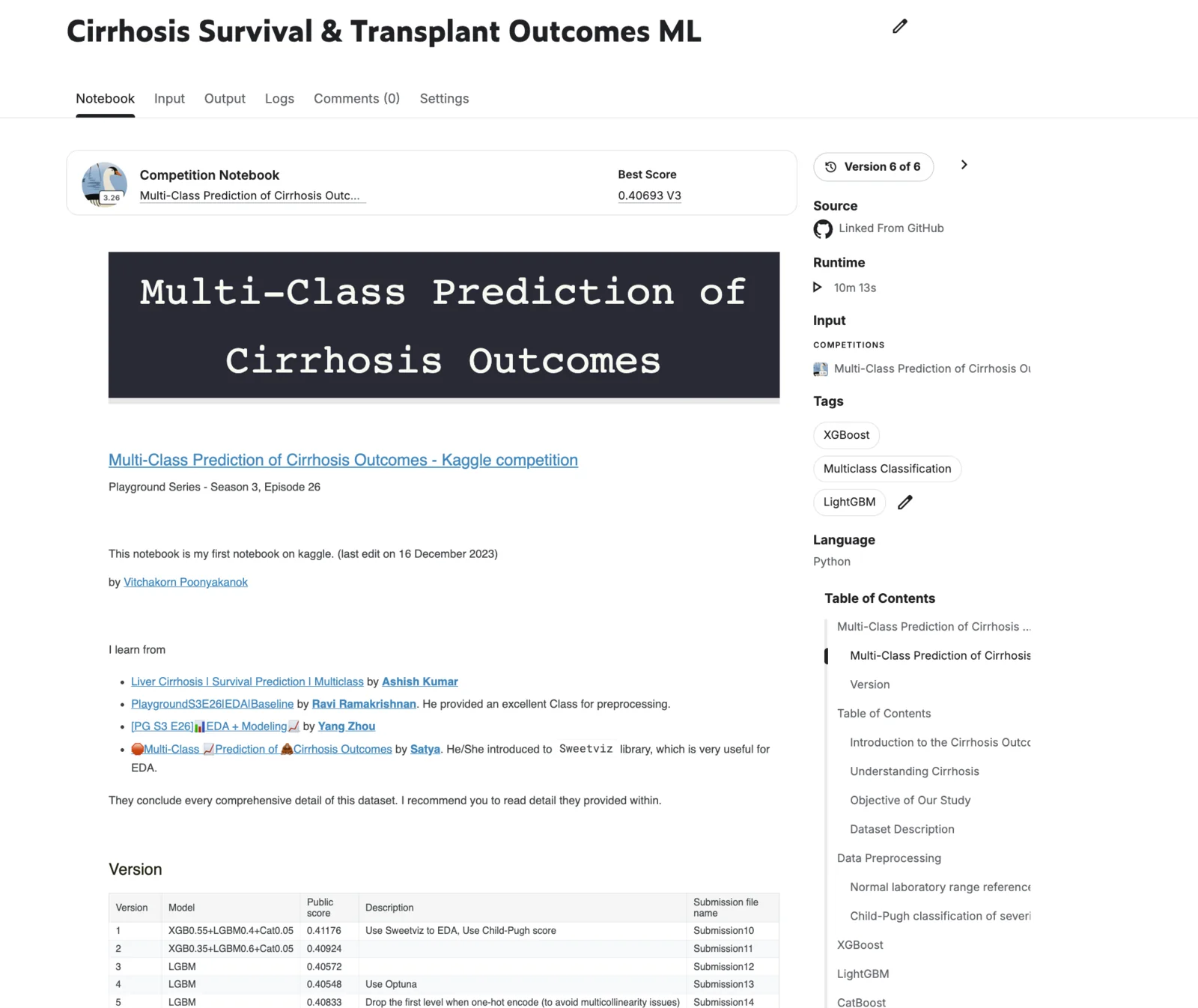
Kaggle’s Playground Series S3E26 asked for the probability of each of three outcomes (alive, alive after a liver transplant, or died) for patients with liver cirrhosis, from their blood tests and examination findings. A spare-time entry, and my first Kaggle notebook.
Approach
Clinical feature engineering first: lab values bucketed against normal ranges, and an approximate Child-Pugh score, the severity score hepatologists use. Then XGBoost, LightGBM and CatBoost, tuned with GridSearchCV and Optuna, singly and as weighted ensembles.
Outcome
221st of 1,663 teams on the final private leaderboard, with a log loss of 0.40194. Among the notebook’s versions the best was a single tuned LightGBM rather than an ensemble, and correcting the clinical thresholds did not improve the score: clinically sensible features don’t always add signal beyond what trees learn from raw values. The task is classification, as the competition framed it, not time-to-event survival analysis.