Hajj Menstrual Delay Planner
A visual, calendar-based counseling tool, in English and Thai, for Hajj and Umrah pilgrims planning menstrual delay or suppression around fixed ritual dates — it tells them whether their next period is likely to fall during Hajj and when medication would need to start. Built to make a time-pressured clinic conversation easier to have.
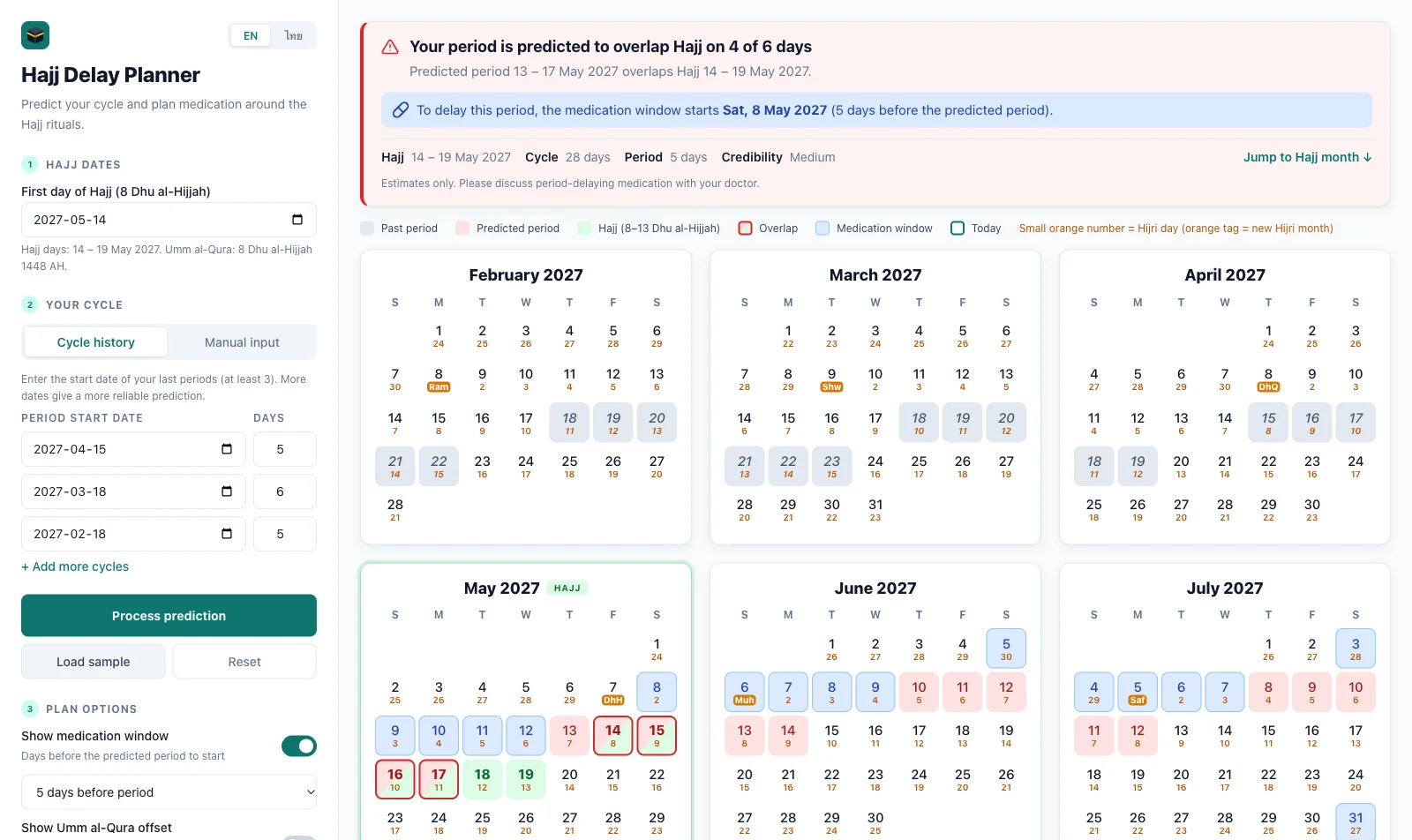
As a travel medicine physician, the author fields frequent, time-pressured questions from Hajj and Umrah pilgrims about delaying or suppressing menstruation so rituals aren't disrupted mid-pilgrimage. Verbal counseling alone struggles to convey cycle variability, medication lead time, and how a delay regimen lines up against the fixed ritual dates — especially across the Hijri/Gregorian calendar gap. The tool was built to give that conversation a shared, visual reference.
A single-page web app in English or Thai, entirely client-side — no health data ever leaves the browser. The user enters the first day of Hajj (8 Dhu al-Hijjah) and either at least three past period start dates or a manual next-period estimate. The app computes a median cycle length and its variability, predicts the next several cycles, and rates how credible that prediction is. Every calendar day carries its Hijri date, checked against Saudi Arabia's Umm al-Qura calendar, so the output lines up with the ritual dates pilgrims are actually given.
The result leads with a plain answer — for example, “Your period is predicted to overlap Hajj on 4 of 6 days” — and, when the medication window is switched on, the date to start medication, a set number of days before the predicted period. Below it, month calendars mark past and predicted periods, the Hajj days, overlap days and the medication window, with a shortcut to the Hajj month. A built-in sample shows how it works before any real dates are entered, and every result reminds the user that these are estimates to discuss with a doctor — turning an abstract conversation about probabilities into a picture a patient can act on.
A live, actively used counseling tool rather than a one-off prototype — it has gone through several rounds of clinical refinement based on real-world use in patient counseling. The latest version added a full Thai interface and leads with the overlap answer and medication start date rather than leaving the patient to read them off the calendar.