Vaccine Schedules Compared
A child who moves country part-way through childhood arrives with doses given at ages the new country does not use, and sometimes without a vaccine the new country gives every child. This tool puts national childhood schedules side by side from birth to 18, as a move between two countries, a timeline, a dose table and a world map, with every schedule traced to the document it came from.
- Result
- Twelve curated national schedules (eight from each country’s own documents, four from its 2025 report to WHO) and 213 countries as reported to WHO, compared from birth to 18. The Immunization Record uses the same schedule data for its comparison.
- My role
- Clinician and domain expert: chose and curated the trusted sources, putting each country’s own schedule document ahead of its report to WHO; designed how the tool reads, from the four views and their layout to how every vaccine is named and abbreviated. Code AI-assisted, including the WHO conversion.
Problem
Countries give the same vaccines at different ages, in different combinations and under different names. When a family moves, the questions in the consultation are which doses the new country expects now, which ones the old country gave that the new one does not count, and whether the schedule being read is still current. Answering them means reading two schedules in different formats and languages, and knowing which document is the official one.
Approach
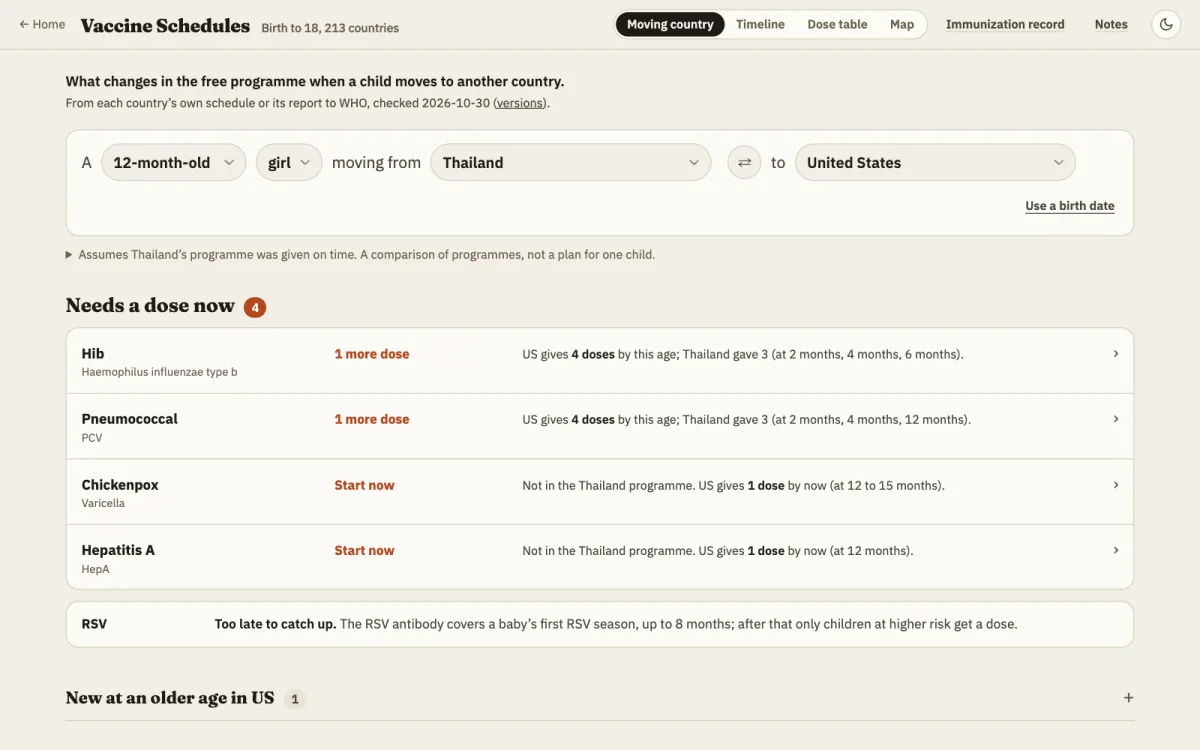
Four views of one dataset. Moving country takes a child’s age, the country they leave and the one they move to, and lists the vaccines that need a dose now, each with its reason. Timeline gives each disease a card and each country a row from birth to 18, on a stretched scale so the first year, where most doses are, takes almost half the width. The Dose table holds the same information in rows, and the Map colours every country for one vaccine by whether its free programme gives it to every child, to part of the country or selected children, or not at all.
Every schedule traced to a source. Thailand, Singapore, Indonesia, Vietnam, Myanmar, the United Kingdom, Germany and the United States come from their own schedule documents; Malaysia, Lao PDR, the Philippines and Japan from the schedule each ministry reports to WHO (2025 round). Each country lists its document, version, the date it was checked and where a newer one would appear, and a Where sources disagree panel records the choices made: Myanmar follows its Ministry of Health chart dated July 2025, which adds a second injected polio dose that the WHO factsheets do not yet show.
Named the way people say it. Each disease is titled with the name a clinician or parent would use, with the other form underneath: Chickenpox over Varicella, Hepatitis A over HepA, Pneumococcal over PCV. Where the abbreviation is the everyday word, it leads and is spelled out below: Hib (Haemophilus influenzae type b), HPV (human papillomavirus). Products that cover the same diseases are grouped (MR, MMR and MMRV; the DTP family), and polio is split into oral (OPV) and injected (IPV) rows because countries give them differently.
Who each dose is for. Marks separate vaccines given to every child from those for risk groups, part of the country, a new rollout or a shared clinical decision, and US rows that a court-stayed change would alter are marked as disputed. Combination vaccines appear under every disease they cover, so a 6-in-1 dose shows under hepatitis B, diphtheria, injected polio and Hib.
Wider coverage, labelled as such. 201 more countries are converted automatically from their reports to WHO and UNICEF, so any country can be added to a comparison, and each is labelled as not checked against the country’s own documents. The map’s country outlines are served with the page; nothing is fetched from other sites.
Outcome
Published as a public tool and linked from the Immunization Record, which counts a child’s recorded doses against the same schedules. Each curated country shows the date its schedule was last checked, because national schedules change.