Taking Children to High Altitude Safely
อ่านบทความนี้เป็นภาษาไทย: พาเด็กเที่ยวพื้นที่สูงอย่างไรให้ปลอดภัย
The article High-Altitude Travel and Altitude Illness explains altitude illness (AMS, HACE, and HAPE) for travelers in general. When children come along, two more questions matter: how clearly can the child describe symptoms, and how quickly can the family change plans or get down? Children can develop altitude problems just as adults can, and a slow ascent remains the main way to prevent them. [1, 2]
Start with the altitude where you sleep
When you read an itinerary, write down the altitude of each night’s accommodation, not just the highest viewpoint. Going up for the day and coming back down to sleep lower generally strains the body less than spending the night up high. If you start from low altitude, avoid going to sleep at 2,750 meters or higher on the first day. Above 3,000 meters, general guidance is to raise your sleeping altitude by no more than about 500 meters per night and to add a rest day for acclimatization for every 1,000 meters gained. These numbers are a planning guide, not a promise that no child will get sick. [2]
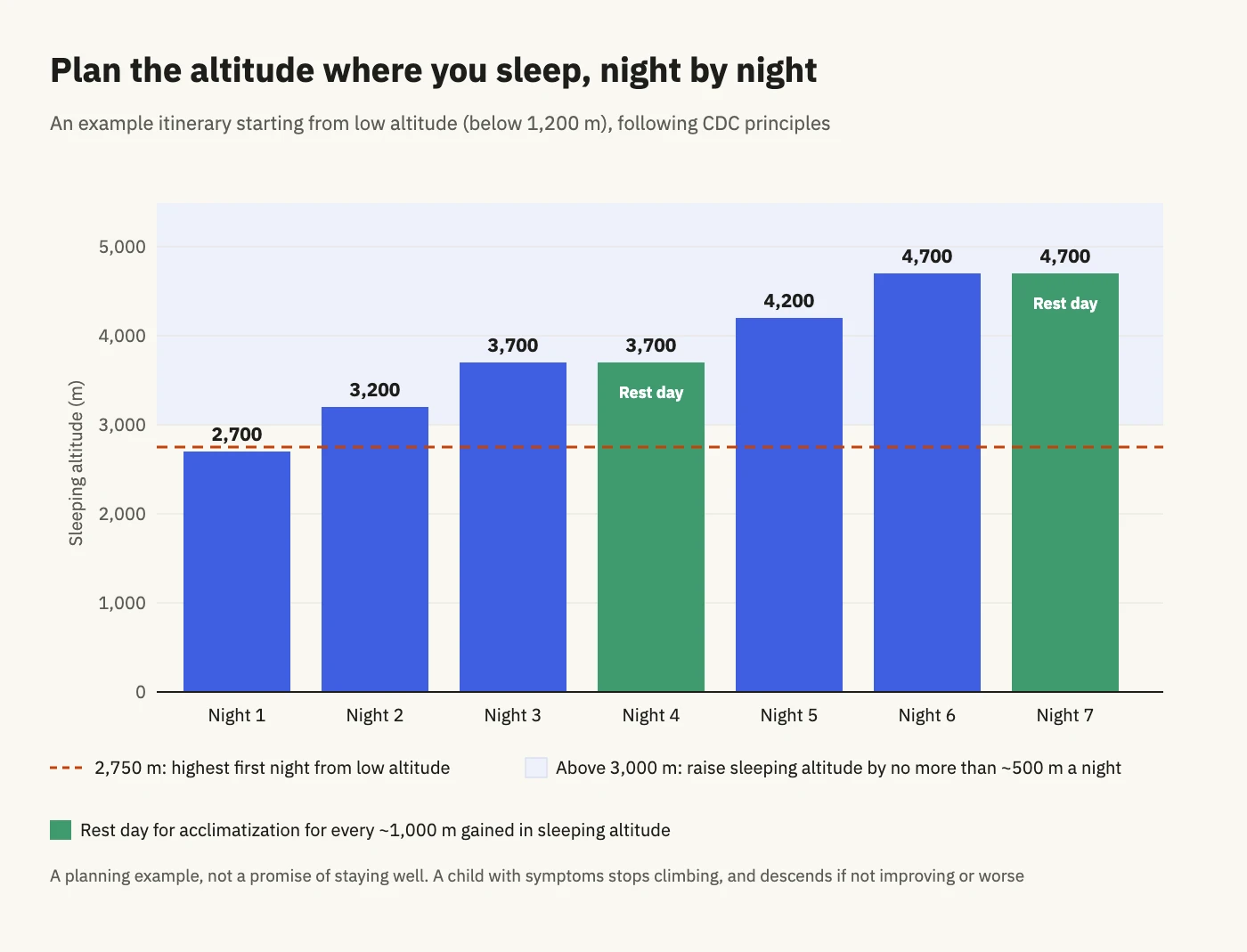
On a family trip, building in rest days and choosing accommodation you can actually get down from matters more than ticking off every destination. Know in advance whom to call, which road a vehicle would take, and where the nearest medical facility is if you have to descend at night, especially at remote destinations. The UIAA guidance stresses that a child’s emergency plan needs a way to descend immediately. [3]
A child may not say “my head hurts”
Older children can say they have a headache, feel dizzy or nauseated, or are unusually tired. Young children may only eat less, be fussier than usual, or sleep or play differently after an ascent. None of these is specific to AMS: fever, dehydration, motion sickness, or another illness are all possible. Look at when the symptoms started, how much altitude was just gained, and what else is going on. Do not make a child keep walking because you assume it is just a bad mood. [1, 3]
The 2018 Lake Louise score
Roach and colleagues revised the Lake Louise Acute Mountain Sickness Score in 2018 to four scored symptoms, dropping sleep disturbance from the AMS score because poor sleep at altitude can come from low oxygen without AMS. The table below reproduces the original wording, so you can see what the questionnaire asks. [4]
| Symptom | 0 points | 1 point | 2 points | 3 points |
|---|---|---|---|---|
| Headache | None at all | A mild headache | Moderate headache | Severe headache, incapacitating |
| Gastrointestinal symptoms | Good appetite | Poor appetite or nausea | Moderate nausea or vomiting | Severe nausea and vomiting, incapacitating |
| Fatigue and/or weakness | Not tired or weak | Mild fatigue/weakness | Moderate fatigue/weakness | Severe fatigue/weakness, incapacitating |
| Dizziness/light-headedness | No dizziness/light-headedness | Mild dizziness/light-headedness | Moderate dizziness/light-headedness | Severe dizziness/light-headedness, incapacitating |
In research, the 2018 criteria apply at least 6 hours after an ascent: a headache score of at least 1 and a total of at least 3 across the four symptoms. The original also has a separate score for the effect on activities, which is not added to the four-symptom total. These criteria are not a rule that a low score means safety: without a headache there can still be an illness that needs clinical assessment, and severe conditions such as HACE or HAPE are handled as emergencies, without waiting for a score. [2, 4]
Which score fits which age?
The 2018 score is self-reported, so it does not transfer directly to children who cannot yet describe their symptoms well. Southard and colleagues found that adult-worded questions led 4- to 11-year-olds to report fewer symptoms than age-appropriate wording, which is why the Lake Louise Age-Adjusted Symptom Score (LLAASS) exists for this age group. For preverbal children there is the Children’s Lake Louise Score (CLLS), which relies on a caregiver observing fussiness, eating, playing, and sleeping. [3, 5, 6]
The LLAASS in the 2008 UIAA document still asks about sleep, because it was built on the pre-2018 score, and the document notes that it had not been adequately validated. Do not mix the thresholds of different versions. Parents can use simple questions such as “Does your head hurt?”, “Can you eat?”, and “Are you tired or dizzy?” together with watching behavior, but deciding to stop climbing, descend, or see a doctor means looking at the whole child, not waiting for a total. [3, 4, 5]
Children aged 4–11: Lake Louise Age-Adjusted Symptom Score (LLAASS)
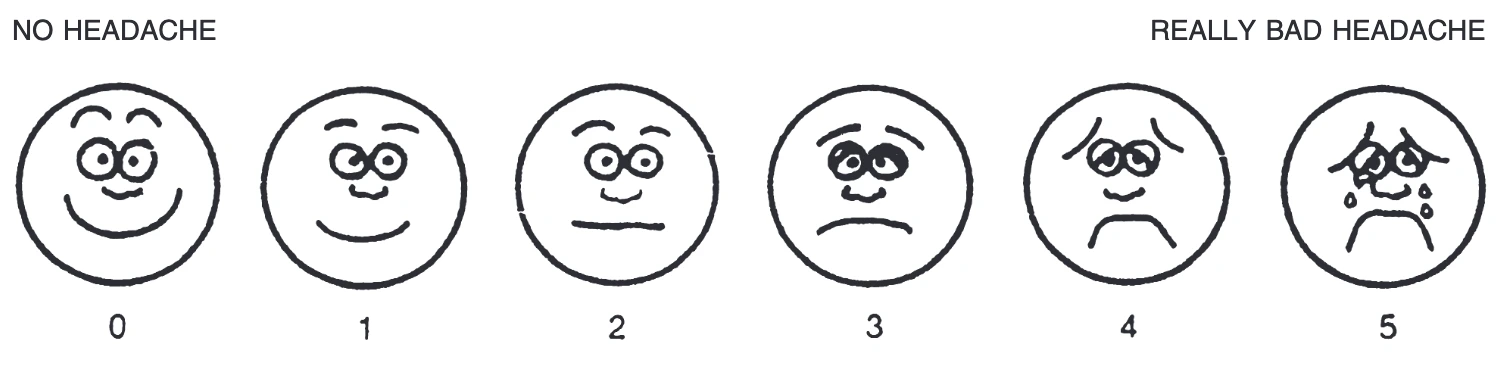
This table uses short questions that children understand more easily. The 0–5 faces below let the child point to how bad a headache is: face 0 = no headache (0 points), face 1 = a little headache (1 point), face 2 = more than a little headache (2 points), and faces 3–5 = really bad headache (all counted as 3 points in the LLAASS table). So the numbers under the faces are not all points to be added directly. [3, 5]
| Ask the child… | 0 points | 1 point | 2 points | 3 points |
|---|---|---|---|---|
| Do you have headache? | No headache | A little headache | More than a little headache | Really bad headache |
| Are you hungry? | Yes, hungry | Not really hungry or a little upset stomach | Upset stomach or throwing up a little | Really upset stomach or throwing up a lot |
| Are you tired? | Not tired | A little tired | More than a little tired | Really tired |
| Are you dizzy? | Not dizzy | Mild dizziness | More than a little dizzy | Really dizzy |
| How did you sleep last night? | Slept as well as usual | Did not sleep as well as usual | Woke up many times during the night | Could not sleep at all |
The UIAA document gives the threshold for this questionnaire as a total of at least 3 points after an ascent with no other clear explanation, but it also states that the LLAASS is not yet validated. The threshold is therefore not a way for families to confirm or rule out AMS, and this version’s sleep points should not be added to the 2018 Lake Louise score. [3, 4]
Children who cannot yet describe symptoms: Children’s Lake Louise Score (CLLS)
In the CLLS, the caregiver rates unexplained fussiness while the child is awake over the past 24 hours, then compares eating, playing, and sleeping with what is normal for the child. The study that evaluated this score enrolled children aged 3–35 months; do not use it for older children in place of asking them about symptoms. [3, 6]
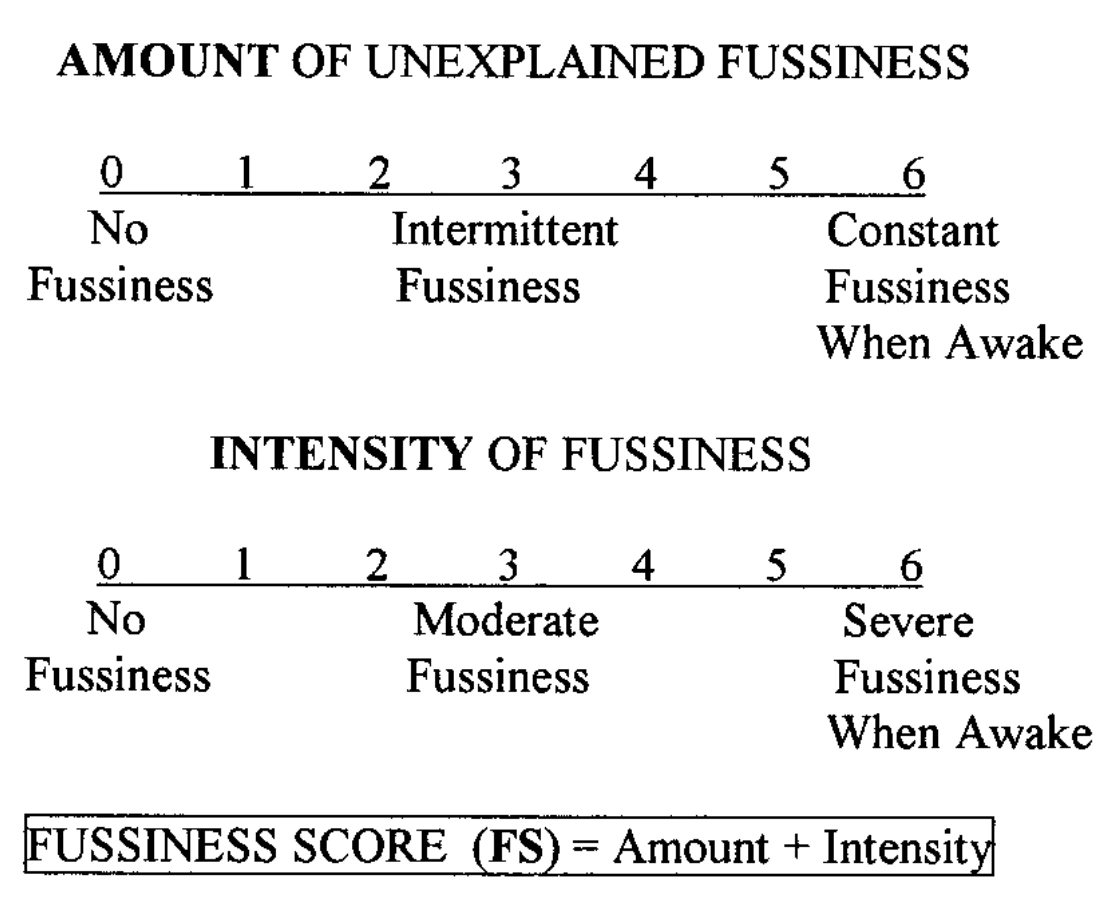
| Fussiness Score (FS) | 0 | Midpoint 3 | 6 |
|---|---|---|---|
| Amount | No fussiness | Intermittent fussiness | Constant fussiness |
| Intensity | No fussiness | Moderate fussiness | Hard crying & extreme fussiness |
Each row is scored 0–6, including the steps between the anchor points, and the two rows are added to give the FS (0–12 points). “Unexplained fussiness” excludes irritability with an obvious cause, such as tiredness, hunger, teething, or pain from an injury. [3]
| What the caregiver rates | 0 points | 1 point | 2 points | 3 points |
|---|---|---|---|---|
| How well the child has eaten today (E) | Normal | Slightly less than normal | Much less than normal | Vomiting or not eating |
| How playful the child is today (P) | Normal | Playing slightly less | Playing much less than normal | Not playing |
| The child’s ability to sleep today (S) | Normal | Slightly less or more than normal | Much less or more than normal | Not able to sleep |
The research formula: CLLS = FS + E + P + S. The investigators’ threshold was a total of at least 7, with FS at least 4 and E + P + S at least 3, after an ascent and with no other clear cause. These numbers come from a small study; never wait for a child to reach the threshold before helping one who has symptoms or is getting worse. [3, 6]
When a child has symptoms after an ascent
- Stop climbing. Let the child rest, watch the symptoms, look for other possible causes, and check whether the child is eating and drinking enough. [2, 3]
- If symptoms get worse or do not improve, descend and get medical help. Do not wait until the end of the planned stay. [2, 3]
- Confusion, unsteady walking, unusual drowsiness, or breathlessness even at rest are emergency signs. They may mean HACE or HAPE: descend quickly and get treatment. Give medical oxygen if it is available, and arrange the descent so the child exerts as little as possible. [2, 3]
Does a child need Diamox before going up?
The first answer is to slow the itinerary down. Every source below agrees that a slow ascent comes before medication, but they differ on how cautious to be about the drug, and even CDC’s own chapters do not say the same thing. [1, 2, 3, 7, 8]
| Question | CDC, children chapter [1] | CDC, altitude chapter [2] | UIAA 2008 [3] | Nelson 2024 [7] | WMS 2024 [8] |
|---|---|---|---|---|---|
| Stance on preventive use | Not approved for altitude illness in children under 12, though some clinicians prescribe it when a slow ascent is not possible | Gives a pediatric dose in its table without a separate age limit | Should be strictly avoided for lack of data, except in very rare cases where a rapid ascent cannot be avoided, and only after medical consultation | Not routinely recommended, but indicated when a rapid ascent cannot be avoided or the child has been ill at altitude on a similar route before | Gives pediatric doses for prevention and treatment |
| Preventive dose | 1.25 mg/kg every 12 h, max 125 mg per dose | Table: 1.25 mg/kg every 12 h, max 125 mg. Text: 2.5–5 mg/kg/day divided, up to 125 mg twice daily | No figure; only says to adjust for body weight | 1.25 mg/kg every 12 h, max 125 mg per dose, starting 24 h before ascent and continuing 2 days at altitude | 1.25 mg/kg every 12 h, max 125 mg per dose, starting the night before ascent |
| Dose for treating AMS | Not addressed | 2.5 mg/kg every 12 h, max 250 mg | 2.5 mg/kg every 8–12 h, max 250 mg per dose (for moderate to severe symptoms, together with descent and oxygen) | 2.5 mg/kg every 12 h, max 250 mg per dose, usually for 48 h | 2.5 mg/kg every 12 h, max 250 mg per dose |
| Evidence in children | — | — | No data or experience | No controlled studies in children, only experience reports | No treatment studies in children, only experience reports |
| Formulation | No liquid form; tablets must be crushed or compounded by a pharmacy | — | — | A pharmacy can compound a liquid | — |
Where the sources disagree:
- Whether to give preventive medication at all. UIAA 2008 is the strictest (avoid in almost every case), while the newer Nelson 2024 and WMS 2024 accept its use when a rapid ascent cannot be avoided. Nelson adds children who have had altitude illness before.
- The preventive dose in CDC’s altitude chapter. Its table gives 1.25 mg/kg per dose, but its text gives 2.5–5 mg/kg/day, whose upper end equals 2.5 mg/kg per dose, twice the table’s figure. Every other source that gives a number uses 1.25 mg/kg per dose.
- How often to give the treatment dose. UIAA allows every 8–12 hours; the others say every 12 hours.
This table shows where the recommendations differ; it is not a guide to giving the drug. The decision has to take into account the child’s age, weight, underlying conditions, drug allergies (especially a previous severe reaction to a sulfonamide), and whether the dose can be prepared accurately. Do not split tablets or calculate a child’s dose yourself from an online article. A doctor should prescribe the drug and set the dose. [1, 3, 7]
If the child has an underlying condition such as heart disease, lung disease, or diabetes, the doctor who manages that condition should help plan the trip. For children with type 1 diabetes, continue with Type 1 Diabetes and High-Altitude Travel, which covers preparing insulin, checking glucose and ketones, and planning for illness. [1]
References
- CDC Yellow Book 2026. Traveling Safely with Infants and Children.
- CDC Yellow Book 2026. High-Altitude Travel and Altitude Illness.
- UIAA Medical Commission. Children at Altitude: Consensus Statement No. 9. 2008.
- Roach RC, Hackett PH, Oelz O, Bärtsch P, Luks AM, MacInnis MJ, et al. The 2018 Lake Louise Acute Mountain Sickness Score. High Alt Med Biol. 2018;19(1):4–6.
- Southard A, Niermeyer S, Yaron M. Language Used in Lake Louise Scoring System Underestimates Symptoms of Acute Mountain Sickness in 4- to 11-Year-Old Children. High Alt Med Biol. 2007;8(2):124–130.
- Yaron M, Niermeyer S, Lindgren KN, Honigman B. Evaluation of Diagnostic Criteria and Incidence of Acute Mountain Sickness in Preverbal Children. Wilderness Environ Med. 2002;13(1):21–26.
- Niermeyer S, Yaron M. Altitude-Associated Illness in Children. In: Kliegman RM, St. Geme JW III, Blum NJ, et al., editors. Nelson Textbook of Pediatrics. 22nd ed. Philadelphia: Elsevier; 2024. Chapter 87.
- Luks AM, Beidleman BA, Freer L, Grissom CK, Keyes LE, McIntosh SE, et al. Wilderness Medical Society Clinical Practice Guidelines for the Prevention, Diagnosis, and Treatment of Acute Altitude Illness: 2024 Update. Wilderness Environ Med. 2024;35(1_suppl):2S–19S.
Written by Vitchakorn Poonyakanok, MD. This article provides general information. Caring for each child depends on the itinerary, the symptoms, and advice from the child’s own doctor.
Comments
Loading comments…
Author mode: replies post as the author